Claude
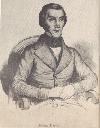
Frederic Bastiat was the master at explaining economic processes and political
fallacies in terms the average non-economist could relate to -- and why
good observers of public policies and their results must go beyond simply
what is seen in the short run and look beyond and beneath to discover what
is usually not seen -- the hidden and longer-range (and often unintended)
consequences.
To read his classic essay, click here -->Text
of "What Is Seen & What Is Not Seen" -- the article which
inspired Henry Hazlitt to write his classic book Economics In One Lesson
a century later.
----------------------------------------------------------
A Petition from the
Candlemakers -- a classic of Bastiat's delightful wit!
What is the Proper Function
of Government -- of Political Law and its Agencies of Enforcement?
In the year 1850,
not long before his untimely death from tuberculosis, Bastiat wrote and
published perhaps the most eloquent essay on the proper role of government
ever written. It is entitled "The Law" and is filled with Bastiat's usual
clarity of expression and profound insights. Click on the following link
and read the full text of the American translation of this classic exposition:
The
Law (HTML version) by Frederic Bastiat
From
Totalitarianism to Laissez Faire Sam Wells This involves a detailed analysis of totalitarianism
and various lesser degrees of statism. Why the opposite of totalitarianism
is the policy of laissez faire, not "anarchy"; the differences between
a constitutional republic and unlimited democracy; different ways of measuring
or representing coercive interventionism into the private affairs and voluntary
relationships of the people; . .
Introduction
to Bastiat's The Law Walter E. Williams The former head of the Economics
Department of George Mason University introduces the classic statement
of the proper function of political government.
Seven
Fallacies of Economics Lawrence W. Reed Michigan economist Lawrence
W. Reed briefly examines -- and puts to rest -- seven widespread fallacies
that keep many people trapped politically.
Great
Myths of the Great Depression Lawrence W. Reed What caused the Great Depression
of the 1930s? And what made it last so long? Understanding the answers
to these questions is the key to avoiding similar debacles in our own time.